
New York Genome Center researchers connect patterns of gene activity to their possible causes, revealing drug effects and hidden immune responses
Single-cell technologies can reveal what individual cells are doing, but often leave a crucial question unanswered: why? Scientists can identify cells that behave differently after a drug treatment or during an infection, yet still struggle to determine which molecular signals produced those changes.
Researchers at the New York Genome Center (NYGC), New York University, and Columbia University have developed RNA fingerprinting to help close that gap. Published today in Cell, the computational method connects changes in gene activity to experiments in which the cause is known, giving researchers specific explanations to test.
The approach draws on growing collections of single-cell experiments in which researchers deliberately disrupt genes, apply drugs, or expose cells to immune signals. These experiments create a reference library of cellular responses. Like matching a fingerprint to a known record, the method searches this library for changes that could explain a cell’s behavior.
“We can now describe cells in extraordinary detail, but understanding what drives their behavior remains a major challenge. RNA fingerprinting uses the results of controlled perturbation experiments to help interpret the changes we observe in new data,” said Rahul Satija, PhD, a senior author of the study.
Co-corresponding author David A Knowles, PhD added, “Traditionally, scientists analyze new experimental data on its own, maybe checking for agreement with one or two related studies. We realized there might be an opportunity to get more insights by placing new data in the context of the wealth of large-scale public reference perturbation datasets, but that there is no framework to do that: RNA fingerprinting fills that gap.”
Making those matches is difficult because cells vary even before an experiment begins, and the same intervention can produce responses of different strengths. RNA fingerprinting separates these sources of variation from the response of interest and evaluates the evidence for possible matches. When the data cannot distinguish among several explanations, it retains that uncertainty.
“The goal is to give researchers a useful starting point for the next experiment: which genes or signals could explain what they are seeing, and how strongly does the evidence support those possibilities?” said Isabella N. Grabski, PhD, a postdoctoral researcher at NYGC and the study’s first author.
Investigating what drugs do inside cells
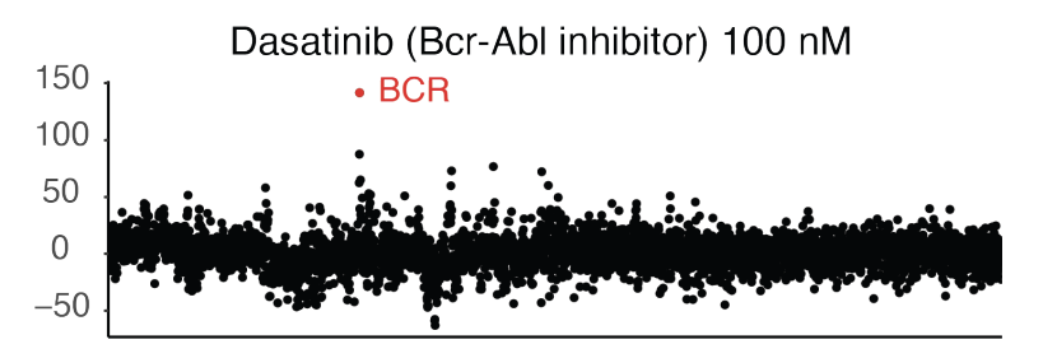
The team first asked whether RNA fingerprinting could identify a drug’s target from the changes it produces inside cells. They compared drug-treated cells with a genome-wide Perturb-seq dictionary containing RNA responses to thousands of individual gene disruptions.
For cells treated with widely used BCR-ABL inhibitors, the search considered thousands of potential genetic perturbations as matches and returned a single hit: BCR. This showed that RNA fingerprinting could use the pattern of gene activity in a cell’s response to help explain how a compound acts. The team obtained similarly specific matches for inhibitors of KDM1A and CDK9.
However, the matches were not equally clear for every drug or dose. For some compounds, changing the dose changed which fingerprints the treated cells matched, likely reflecting shifts in drug specificity. A compound that acts mainly on one target at a lower dose may affect additional targets as its concentration increases.
The researchers explored this further with two compounds described as selective inhibitors of HDAC6, an enzyme within a larger family of drug targets. Across eight doses, neither compound’s RNA profile matched selective HDAC6 disruption. At lower doses, the profiles remained unassigned; at higher doses, they matched broader HDAC inhibition. Under the conditions tested, the changes in gene activity suggested that the compounds were acting more broadly than intended.
Together, these results show how RNA fingerprinting can help researchers investigate both a drug’s intended action and how its effects change with dose.
From drug responses to cellular stress and immunity
The team also used the approach to investigate why disrupting the same gene can produce different responses in different cell types. By analyzing differences in the RNA fingerprints after perturbing cells containing either normal or mutated copies of the tumor suppressor gene p53, the team identified RPL10 and RPL24 as potential regulators of p53 response under ribosomal stress. Follow-up experiments showed that depleting RPL10 or RPL24 impaired p53 activation during ribosomal stress; treatment with a p53-activating compound restored the response.
In a separate application, the researchers analyzed immune cells from mice following a second influenza infection. RNA fingerprinting distinguished B cells with responses associated with different immune signals, including type I interferons and interferon-gamma. These differences were not apparent through conventional single-cell analysis, showing how the method can reveal responses hidden within a cell population.
The team has made RNA fingerprinting available as open-source software so other researchers can apply it to their own datasets. “These reference experiments can have value far beyond the studies that generated them,” said Grabski. “As they cover more cell types and biological signals, we hope researchers will be able to use them to explain an increasingly wide range of cellular responses. We’re excited to see what researchers discover when they bring their own biological questions and datasets to this approach.”
The study, “Mapping transcriptional responses to cellular perturbation dictionaries with RNA fingerprinting,” was led by Satija, an NYGC Core Faculty Member and Professor of Genomics & Systems Biology at NYU, and Knowles, an NYGC Core Faculty Member and Associate Professor of Computer Science at Columbia University. Additional authors include Junsuk Lee, John D. Blair, Carol Dalgarno, Isabella Mascio, and Alexandra Bradu.
The work was supported by the Chan Zuckerberg Initiative (EOSS-0000000082, HCA-A-1704-01895), the National Institutes of Health (RM1HG011014, 1OT2OD026673-, R01HD096770, R35NS097404), and the MacMillan family and the MacMillan Center for the Study of the Non-Coding Cancer Genome at the New York Genome Center. Isabella N. Grabski is the Kenneth G. Langone Quantitative Biology Fellow of the Damon Runyon Cancer Research Foundation (DRQ-21-24).
About the New York Genome Center
The NYGC is an independent, nonprofit academic research institution at the forefront of transforming biomedical research and clinical care. Founded as a collaborative venture by the region’s premier academic, medical, and industry leaders, the NYGC aims to accelerate the translation of genomic research into new diagnostics, therapeutics, and treatments for human disease. NYGC member organizations and partners are united in an unprecedented collaboration of technology, science, and medicine that is designed to harness the power of innovation and discoveries to advance medical genomics and precision medicine and to benefit patients around the world.
Our institutional founding members include Cold Spring Harbor Laboratory, Columbia University, Memorial Sloan Kettering Cancer Center, NewYork-Presbyterian Hospital, New York University, Northwell Health, The Rockefeller University, and Weill Cornell Medicine. Our associate members include the American Museum of Natural History and the Hospital for Special Surgery.
Learn more at nygenome.org


