Researchers at the New York Genome Center (NYGC) have developed Lancet2, an advanced, open-source computational method that significantly improves the detection of somatic variants across the genome. The new tool builds on the widely used Lancet algorithm and introduces major advances in accuracy, speed, and scalability—addressing longstanding challenges in identifying mutations critical to cancer and other diseases.
Accurately detecting small but consequential genetic changes, including insertions and deletions (InDels), remains difficult for conventional analysis methods due to technical limitations and bias toward the human reference genome. Lancet2 overcomes these challenges by using local assembly and joint analysis of tumor and matched normal sequencing data, enabling more precise identification of rare and difficult-to-characterize variants.
Lancet2 incorporates several key innovations, including improved variant discovery and genotyping through partial-order multiple sequence alignment, enhanced somatic variant scoring using explainable machine learning models, and integration with SequenceTubeMap for intuitive visualization of complex genomic regions.
“In developing Lancet2, our goal was to build a tool that could more accurately capture complex variants while also scaling to the growing size and complexity of modern sequencing datasets,” said Rajeeva Musunuri, the main developer of Lancet2 and a Bioinformatics Data Scientist at NYGC.
“Lancet2 substantially extends the capabilities of our original Lancet tool and offers clear advantages over competitive approaches,” said Giuseppe Narzisi, PhD, Associate Director of Computational Biology at NYGC. “These improvements open new opportunities for understanding disease mechanisms and advancing precision medicine.”
In benchmarking studies using high-quality tumor-normal datasets generated from both short-read (Illumina) and long-read (Oxford Nanopore) sequencing technologies, Lancet2 outperformed leading industry tools, particularly in detecting InDels. The method also delivers substantial performance gains, running approximately 10 times faster than the original Lancet while using 50% less memory, and achieving at least 2x speed improvements over many current state-of-the-art variant callers.
“Accurately calling somatic variation remains an import and challenging problem.” said Michael Zody, PhD, Senior Vice President of Informatics at NYGC. “The greatly improved performance of Lancet2 will allow users to apply this unique approach more broadly to their research.”
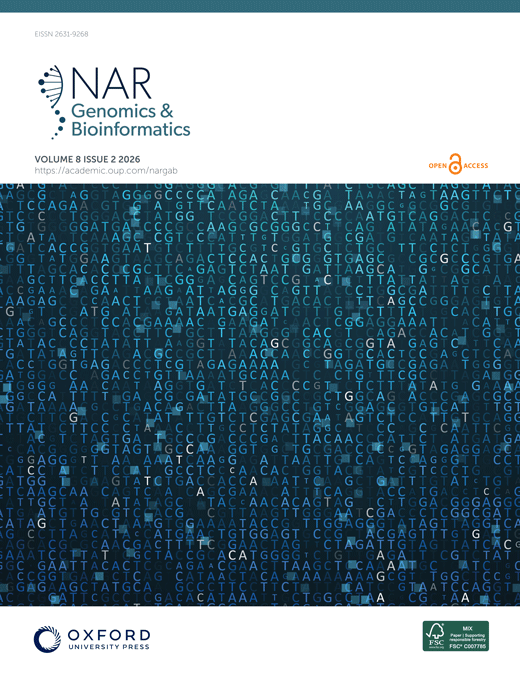
The Lancet2 manuscript, published in NAR Genomics and Bioinformatics and selected as an Editor’s Choice article, highlights the tool’s significance to the genomics community. The research was supported by funding from the Informatics Technology for Cancer Research (ITCR) program of the National Cancer Institute at NIH. Lancet2 is freely available as open-source software, enabling researchers worldwide to apply the method to large-scale genomic studies.
With broad applications in somatic mosaicism, cancer, and other genomic research, Lancet2 provides scientists with a powerful new tool to accelerate discovery and improve the translation of genomic insights into clinical impact.
###
About the NYGC
The NYGC is an independent, nonprofit academic research institution at the forefront of transforming biomedical research and clinical care. Founded as a collaborative venture by the region’s premier academic, medical, and industry leaders, the NYGC aims to accelerate the translation of genomic research into new diagnostics, therapeutics, and treatments for human disease. NYGC member organizations and partners are united in an unprecedented collaboration of technology, science, and medicine that is designed to harness the power of innovation and discoveries to advance medical genomics and precision medicine and to benefit patients around the world.
Our institutional founding members include Cold Spring Harbor Laboratory, Columbia University, Memorial Sloan Kettering Cancer Center, NewYork-Presbyterian Hospital, New York University, Northwell Health, The Rockefeller University, and Weill Cornell Medicine. Our associate members include the American Museum of Natural History and the Hospital for Special Surgery. Learn more at nygenome.org.


