
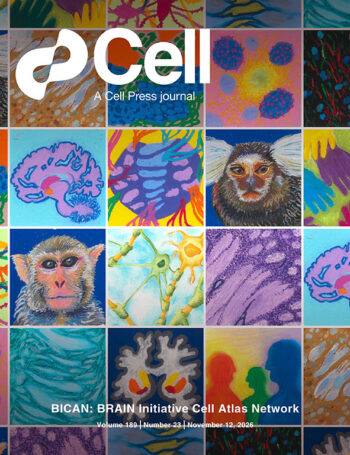
Complementary brain atlases spanning humans, mice, and other primates connect advances in single-cell genomics with discoveries about gene activation and repression, providing new resources for neuroscience research.
Four studies from the laboratory of Bing Ren, PhD, CEO and Scientific Director of NYGC (NYGC), and collaborating institutions appear in the same issue of Cell. Collectively, they address a central question in neuroscience: how cells with essentially the same DNA sequence develop and maintain the many distinct identities found in the brain. The studies combine single-cell genomic technologies and computational models to examine how genes are activated or kept silent across brain cell populations, while establishing standardized resources for comparing cell types across species. Their findings reveal regulatory patterns associated with neuronal identity and molecular traces of cells’ developmental history, while providing valuable resources for investigating how genetic variation may influence brain disorders.
“These studies grew out of years of technology development and collaboration,” said Bing Ren, PhD, CEO and Scientific Director of the New York Genome Center. “They bring us closer to understanding how the same genome supports the diversity of cells in the brain. By examining both gene activation and repression, we can begin to identify the regulatory programs that distinguish these cells and investigate how those programs may be affected by genetic variation.”
Four Complementary Views of Brain Gene Regulation.
Two of the studies are part of the National Institutes of Health’s BRAIN Initiative Cell Atlas Network (BICAN). Together, the two human brain studies profile more than 1.3 million nuclei and contribute detailed maps of gene regulation to the consortium’s broader effort to understand brain cell diversity. The complementary mouse and multispecies studies extend these findings, providing additional insights into gene regulation and establishing shared resources for comparing brain cell types across species.
The human basal ganglia study examines more than 608,000 nuclei from eight regions involved in movement, learning, cognition, and other functions. It identifies distinct combinations of homeobox transcription factors—proteins that regulate gene activity—associated with neuronal populations and their chromatin states. These findings support a model in which combinations of these factors help define neuronal identity.
The second human study analyzed more than 750,000 nuclei from 18 regions of the brain, revealing how patterns of gene regulation reflect where brain cells originated and how they are organized. Researchers also identified previously unrecognized interactions within DNA that may help neurons maintain their identity and function over time.
The third study, “An Integrative Single-Cell Epigenomic Atlas Annotates the Regulatory Genome of the Adult Mouse Brain,” analyzed more than 2.5 million nuclei from the adult mouse brain, mapping more than 100 brain cell types and regulatory features across approximately 81% of the mouse genome. The study also identified DNA regions involved in controlling gene activity and developed new methods to predict gene regulation, providing a valuable resource for understanding brain function and neurological disease.
The fourth study, “A Community Standard Multispecies Cell Atlas of the Basal Ganglia,” brings together genomic data from humans, macaques, marmosets, and mice to establish a standardized reference for comparing brain cell types across species. Developed through the BICAN collaboration, the atlas integrates gene activity, regulation, and cellular organization to help researchers understand similarities and differences across species and advance research into brain development, function, and neurological disorders.
Technology That Makes Biological Questions Accessible
Central to these achievements is the Ren laboratory’s development and application of advanced single-cell genomic technologies, including Paired-Tag and Droplet Paired-Tag, which enable researchers to simultaneously examine gene expression and histone modifications within individual cells. Histones are proteins around which DNA is packaged; their chemical modifications provide information about active and repressive chromatin states.
By combining these technologies with artificial intelligence and computational analysis, researchers can investigate how gene activation and repression work together to maintain cellular identity and predict how genetic variation may influence gene regulation.
Computational modeling extends the value of these maps. Using datasets from the two human studies, the researchers developed EpiBRAIN, a deep-learning model for predicting cell-type-specific epigenomic features and gene expression from DNA sequence. Its predictions can help prioritize noncoding genetic variants for experiments to test their possible effects on gene regulation. The mouse study’s predictive models provide a complementary framework for investigating relationships between DNA sequence and regulatory activity.
The multispecies atlas further extends the value of these resources by establishing common standards for organizing and comparing genomic data across species. Its integrated framework allows researchers to connect findings from human brain studies with those from animal models, supporting more consistent comparisons and broader collaborative research.
Resources For Investigating Brain Disorders
Many genetic variants associated with neurological and psychiatric traits lie outside protein-coding genes. Determining which regulatory elements, genes, and cell types they may affect remains a major challenge. The new atlases and models help researchers formulate specific hypotheses about these relationships and select candidates for experimental investigation.
The multispecies atlas adds another important dimension by enabling scientists to examine how brain cell types and their molecular characteristics compare across humans and commonly studied animal models. These comparisons can help researchers better interpret experimental findings and identify biological features that may be relevant to understanding human brain disorders.
Together, the studies provide foundational reference maps and analytical tools to advance this work. Further research and experimentation will be needed to determine how specific genetic variants affect cell function and contribute to disease, as well as to explore the potential for translating these insights into future treatments.
A Shared Foundation For Future Discovery
The four studies illustrate how investment in genomic technology, computational methods, and collaborative science can generate both biological discoveries and resources for the wider research community. Their complementary scope connects detailed human brain studies with a mouse reference and a standardized multispecies atlas, creating a broader framework for investigating brain cell identity and gene regulation.
For NYGC, these studies reflect a scientific vision centered on working together to advance genomic science and disease research. Making the atlases and tools available enables other laboratories to pursue new questions about brain cell identity, gene regulation, and disease mechanisms.
“The next discoveries will depend on what the research community does with these resources,” said Ren. “We hope they will help scientists design more precise experiments and uncover how gene regulation contributes to brain function and disease.”
Explore the Atlases
Human Basal Ganglia Epigenome Atlas
Adult Mouse Brain Epigenome Atlas
Multispecies Basal Ganglia Cell Atlas
About the New York Genome Center
The NYGC is an independent, nonprofit academic research institution at the forefront of transforming biomedical research and clinical care. Founded as a collaborative venture by the region’s premier academic, medical, and industry leaders, the NYGC aims to accelerate the translation of genomic research into new diagnostics, therapeutics, and treatments for human disease. NYGC member organizations and partners are united in an unprecedented collaboration of technology, science, and medicine that is designed to harness the power of innovation and discoveries to advance medical genomics and precision medicine and to benefit patients around the world.
Our institutional founding members include Cold Spring Harbor Laboratory, Columbia University, Memorial Sloan Kettering Cancer Center, NewYork-Presbyterian Hospital, New York University, Northwell Health, The Rockefeller University, and Weill Cornell Medicine. Our associate members include the American Museum of Natural History and the Hospital for Special Surgery.
Learn more at nygenome.org


