
A single-cell study in Science reveals major shifts in immune cells, genome organization and gene regulation in the aging human hippocampus. These findings offer critical insights into brain aging with major implications for age-related dementias.
Researchers have discovered that the human brain undergoes widespread age-related changes in genome regulation beginning in midlife that may help explain why aging is the greatest risk factor for neurodegenerative diseases such as Alzheimer’s.
In a new study published in Science, researchers used cutting-edge single-cell technologies to profile gene regulation and three-dimensional genome architecture in individual cells from the human hippocampus, the brain region critical for learning and memory. By examining brain samples across the adult lifespan, the team generated one of the most comprehensive views to date of how genome regulation changes during brain aging.
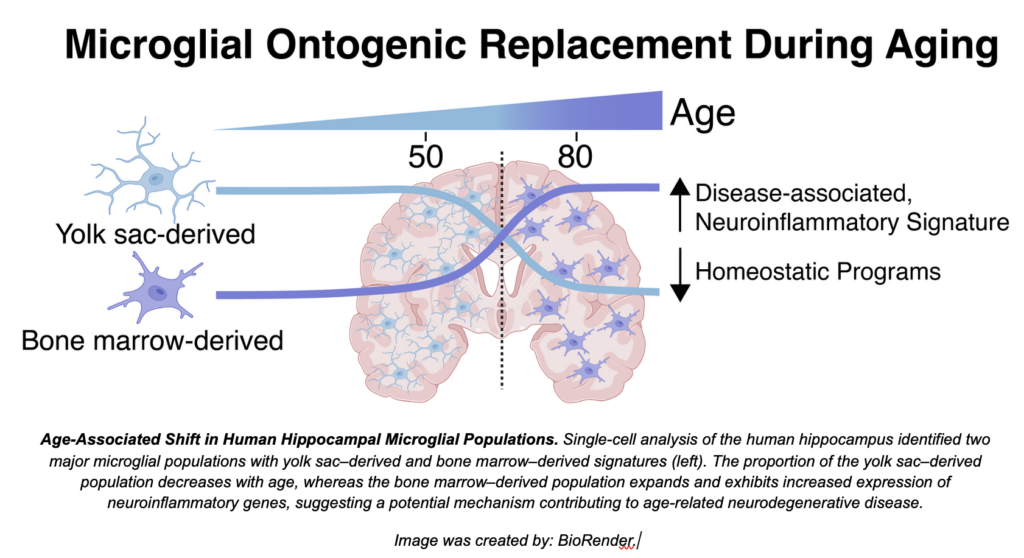
One of the study’s most striking findings was a dramatic shift in microglia, the brain’s immune cells, between approximately ages 50 and 75. Microglia that originate during embryonic development declined substantially and were replaced by cells with molecular signatures that resemble immune cells from the blood. This finding challenges the longstanding view that microglia established during embryonic development persist throughout the human lifespan. These replacement microglia-like cells exhibited elevated inflammatory signatures, suggesting they may contribute to chronic neuroinflammation in the aging human brain. The scientists also observed a substantial decline in cell populations important for maintaining the blood-brain barrier, which protects the brain from harmful substances in the bloodstream.
“Microglia are critical for maintaining brain homeostasis,” said Bing Ren, PhD, a corresponding author of the study, Scientific Director and CEO of the New York Genome Center, Professor of Genetics and Development, Biochemistry and Molecular Biophysics, and Systems Biology at Columbia University, and Associate Director in the Vagelos Institute for Basic Biomedical Science (Vagelos Institute) in VP&S, Columbia University, “When these cells fail to perform their housekeeping duties, toxic materials accumulate that can trigger inflammatory processes that may contribute to neurodegenerative diseases.”
Across multiple brain cell types, researchers also observed a global erosion of three-dimensional genome architecture, suggesting that structural breakdown of the genome may be a fundamental hallmark of brain aging. “This work represents a major step forward in understanding how aging reshapes the human genome in brain cells,” said Nathan Zemke, Director of Single-cell Genomics at the Center for Epigenomics at UC San Diego. “These findings demonstrate a critical need for studying gene regulation and genome organization to gain a mechanistic understanding of the aging process.”
“Importantly, this study reveals that aging is not simply a gradual decline, but involves coordinated and dynamic remodeling of immune, vascular, and neuronal systems. These findings open the door to identifying new therapeutic targets aimed at preserving circuit integrity and brain function across the lifespan,” said Xiangmin Xu, PhD, Chancellor’s Professor and Director of the Center for Neural Circuit Mapping at the University of California, Irvine, and a co-corresponding author of the study.
This work is one of six papers published in Science as part of the National Institutes of Health’s 4D Nucleome (4DN) Common Fund program, a decade-long initiative designed to map the dynamic architecture of the genome in space and time. The 4D Nucleome program brought together interdisciplinary teams from across the country between 2015 and 2025 to better understand how the genome’s spatial organization influences biological processes. In addition to this study, Dr. Ren also contributed as a co-corresponding author or co-author on three additional Science papers exploring genome architecture across diverse cell types and timescales.
Collectively, these studies provide a foundational resource for the scientific community and open new avenues for understanding how disruptions in genome organization contribute to development, aging, and disease—including neurodegenerative disease.
For more information about the NIH 4D Nucleome program, visit https://commonfund.nih.gov/4DNucleome.
###
About the NYGC
The NYGC is an independent, nonprofit academic research institution at the forefront of transforming biomedical research and clinical care. Founded as a collaborative venture by the region’s premier academic, medical, and industry leaders, the NYGC aims to accelerate the translation of genomic research into new diagnostics, therapeutics, and treatments for human disease. NYGC member organizations and partners are united in an unprecedented collaboration of technology, science, and medicine that is designed to harness the power of innovation and discoveries to advance medical genomics and precision medicine and to benefit patients around the world.
Our institutional founding members include Cold Spring Harbor Laboratory, Columbia University, Memorial Sloan Kettering Cancer Center, NewYork-Presbyterian Hospital, New York University, Northwell Health, The Rockefeller University, and Weill Cornell Medicine. Our associate members include the American Museum of Natural History and the Hospital for Special Surgery. Learn more at nygenome.org.


