
Multimodal analysis of the human brain uncovers region- and cell-specific mechanisms underlying the cognitive symptoms of amyotrophic lateral sclerosis
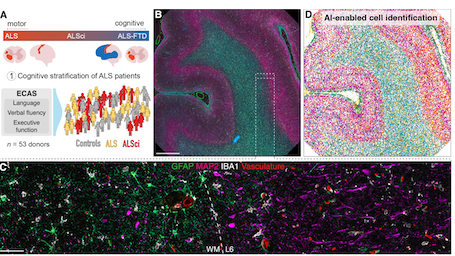
Researchers at the New York Genome Center (NYGC) and collaborating institutions have uncovered distinct biological mechanisms that drive cognitive impairment in amyotrophic lateral sclerosis (ALS), offering new insight into why the disease affects thinking and language differently from one patient to another. Published today in Cell, the study combines single-cell genomics, spatial transcriptomics, and advanced imaging to create one of the most comprehensive molecular maps of the ALS brain to date, revealing that the cognitive symptoms of ALS arise from diverse cellular and molecular changes rather than a single underlying disease process.
Although ALS is best known for the progressive loss of motor neurons that control movement, up to half of people living with the disease also experience cognitive and/or behavioral impairment, ranging from subtle changes in language and executive function to ALS with frontotemporal dementia. While these symptoms have long been associated with the accumulation of the protein TDP-43, the biological basis for their remarkable diversity has remained largely unknown.
Using an integrated multimodal approach, the research team analyzed postmortem brain tissue at unprecedented resolution, combining single-nucleus RNA sequencing, spatial transcriptomics, and high-dimensional imaging to examine gene activity, cellular organization, and tissue architecture simultaneously. This approach enabled the investigators to connect molecular changes with specific brain regions, cortical layers, and cell types, revealing that different patterns of cognitive impairment are associated with distinct biological processes.
Rather than identifying a single mechanism responsible for cognitive decline, the study demonstrates that language and verbal fluency impairments are associated with widespread glial and vascular responses across the cortex, while executive dysfunction is linked to alterations in deep-layer neurons involved in higher-order cognition, including disruptions in synaptic signaling and mitochondrial function. Together, these findings show that the cognitive heterogeneity observed in ALS reflects multiple interacting cellular pathways that extend beyond classical TDP-43 proteinopathy, providing a more nuanced understanding of the disease and identifying new opportunities for therapeutic intervention.
“We’ve known that ALS can affect cognition, but we haven’t fully understood why those symptoms vary so dramatically from one person to another,” said lead author, Dr. Hemali Phatnani, Core Faculty Member, Director, Center for Genomics of Neurodegenerative Disease, NYGC, and Assistant Professor of Neurological Sciences (in Neurology), Columbia University. “By integrating single-cell genomics, spatial transcriptomics, and advanced imaging, we found that different forms of cognitive impairment may arise from distinct biological processes involving different cell types and brain regions. This work provides a new framework for understanding ALS and may ultimately help guide the development of more precise therapies.”
Beyond its biological discoveries, the study highlights the power of integrating complementary genomic and imaging technologies to study complex neurological disease. By preserving the spatial organization of cells within intact brain tissue while simultaneously measuring gene expression, the researchers were able to uncover relationships that would have been difficult to detect using any single technology alone.
The resulting atlas provides an important resource for the ALS research community and establishes a framework for investigating how different cell types interact during neurodegeneration. More broadly, the findings suggest that future therapeutic strategies for ALS-associated cognitive impairment may need to target multiple biological pathways, rather than a single pathological hallmark.
Publication: Cell (2026)
About the New York Genome Center
About the NYGC
The NYGC is an independent, nonprofit academic research institution at the forefront of transforming biomedical research and clinical care. Founded as a collaborative venture by the region’s premier academic, medical, and industry leaders, the NYGC aims to accelerate the translation of genomic research into new diagnostics, therapeutics, and treatments for human disease. NYGC member organizations and partners are united in an unprecedented collaboration of technology, science, and medicine that is designed to harness the power of innovation and discoveries to advance medical genomics and precision medicine and to benefit patients around the world.
Our institutional founding members include Cold Spring Harbor Laboratory, Columbia University, Memorial Sloan Kettering Cancer Center, NewYork-Presbyterian Hospital, New York University, Northwell Health, The Rockefeller University, and Weill Cornell Medicine. Our associate members include the American Museum of Natural History and the Hospital for Special Surgery. Learn more at nygenome.org.


