
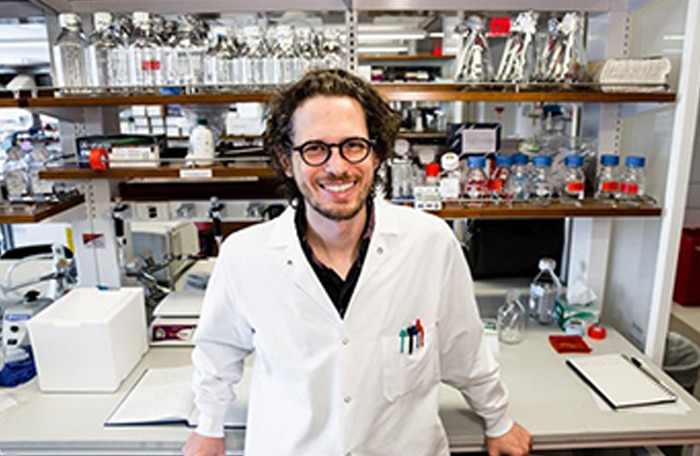
Embracing the transformational potential of new molecular profiling and artificial-intelligence-based data processing technologies on clinical and scientific innovation, Weill Cornell Medicine has created a new research department, the Department of Systems and Computational Biomedicine. Dr. Dan Landau, an internationally recognized cancer researcher and geneticist whose pioneering advances include single-cell-profiling technology innovation and an artificial intelligence-powered liquid biopsy for detecting tumor DNA in blood, will serve as the department’s inaugural chair, effective Sept. 1.
The Department of Systems and Computational Biomedicine consolidates elements of the existing Department of Physiology and Biophysics, the Institute for Computational Biomedicine, and other computation-centered and systems biology faculty and facilities. Its establishment reflects a multiyear initiative to realign and optimize the organization of basic and translational science to facilitate interdisciplinary research and promote mentorship of faculty at all levels.
The new department will be a catalyst for collaborative research at Weill Cornell Medicine integrating advanced genomics and patient-focused technologies that generate large and complex datasets, with computational approaches—including artificial intelligence—that allow researchers to gain unprecedented insights into the drivers of disease. These findings will enable scientists to more precisely and dynamically predict risk for adverse health outcomes and create strategies to intervene before disease occurrence. Dr. Landau will recruit new faculty, computational staff, and computing and laboratory resources to help realize this vision.
Dr. Landau is a clinician, scientist and technology developer who has made major contributions to the understanding of how cancers originate and progress. He joined Weill Cornell in 2016 and is currently the Bibliowicz Family Professor of Medicine, a professor of medicine and of systems and computational biomedicine. He also is a member of the Sandra and Edward Meyer Cancer Center and the Englander Institute for Precision Medicine at Weill Cornell; a core faculty member of the New York Genome Center; and an oncologist at NewYork-Presbyterian/Weill Cornell Medical Center.
“Dr. Landau is a brilliant physician-scientist and entrepreneur who has a bold vision for how Weill Cornell Medicine can trailblaze a new era in data science,” said Dr. Robert A. Harrington, the Stephen and Suzanne Weiss Dean of Weill Cornell Medicine and provost for medical affairs of Cornell University. “Under Dr. Landau’s leadership, the Department of Systems and Computational Biomedicine will harness cutting-edge computational approaches to illuminate how disease develops and, working together with clinicians, use this data to forge innovative prevention and treatment strategies. This is truly a transformative moment in science, and I am thrilled Dr. Landau is leading the way.”
“It is an honor to serve as the inaugural chair,” Dr. Landau said. “Our ability to produce patient-derived data at a scale never before imagined is complemented by artificial intelligence, enabling us to use this data in exciting new ways. This convergence is a really unique moment in the history of biomedical sciences and one that gives us a mandate to dream big, to think about how we as a scientific and clinical community can rise up to this moment and be a leader in shaping the future of medicine.”
The department’s creation, along with an endowed professorship held by the chair, is funded in part by a $20 million gift to Cornell University from philanthropists Andrew and Ann Tisch. In his new role, Dr. Landau will become the Andrew H. and Ann R. Tisch Professor of Systems and Computational Biomedicine at Weill Cornell Medicine. The gift is intended to foster collaboration in this area of research across Weill Cornell, Cornell Tech and the Ithaca campus.
To Dr. Landau, collaboration is essential to his vision for the new endeavor, leveraging strong relationships with Cornell’s other campuses, peer scientific and clinical centers in New York City, and with biotech leaders and frontier AI laboratories.
“Artificial intelligence applications thrive at larger scales, so to really tap into this transformative moment for biomedicine, we can’t be thinking at the level of individual labs,” Dr. Landau said. “We need to be thinking in terms of a coalition of people with a shared, exciting vision and out-of-the-box ways of bringing this vision to life.”
A central goal of the new department will be the construction of large, human-patient-derived datasets that integrate disparate information collected from DNA-sequencing and other forms of molecular profiling, physiological monitoring from mobile and wearable health-tracker devices, electronic health records, medical imaging and clinical outcomes. If built thoughtfully, Dr. Landau said, these datasets will be a foundation upon which a new future for biomedical research and medical practice can be built—one that offers innovative solutions to some of society’s most intractable health problems. They will serve as the bedrock of cutting-edge, continuously evolving AI models that can help reimagine the basic tenets of medical care—including individualized risk assessments, prevention and treatment strategies—provide rich insights that could lead to next-generation therapeutics and unearth new lines of scientific inquiry. To empower this vision, the department will also focus on developing powerful new measurement technologies.
“Historically, many of the largest scientific advances have followed advances in measurement technology,” Dr. Landau said. “We will establish an innovation laboratory focused on molecular measurement technologies for the AI era, to allow Weill Cornell to create its own high-dimensional biological datasets at scale.”
Dr. Landau is excited to build a robust and thriving computational biology community, relying on existing outstanding faculty, cross-institutional collaborations and initiatives, as well as an extraordinary pool of trainees across basic sciences and clinical medicine. In addition, the department will recruit five to seven junior faculty and one to two mid-career investigators in key areas of computational biology and artificial intelligence, with emphasis on individuals who can forge close collaboration with basic scientists and clinicians across Weill Cornell. Some recruitments will explicitly follow a joint recruitment structure with other academic departments, to further support a close integration between the new department and existing strengths within the institute.
The new department will have dedicated physical areas supporting a collaborative intellectual environment, including space for a large molecular innovation laboratory focused on developing new data-generation technologies. Weill Cornell administration has committed to providing new space for the department’s laboratories in newly acquired floors of 1334 York Ave, which will serve as a new home for the department and the nexus for a community committed to leading the frontier of AI integration in biomedicine.
Read more about Dr. Dan Landau
This write-up has been adapted from Weill Cornell Medicine


